Elthon is a medication used to treat abnormal gastrointestinal symptoms in functional dyspepsia or chronic gastritis (non-ulcer dyspepsia). So, what is Elthon used for, and is it safe for long-term use?
1. What is Elthon?
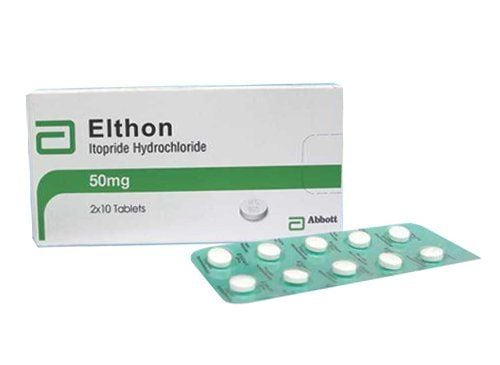
Elthon contains the active ingredient Itopride hydrochloride at a strength of 50mg, along with other excipients such as lactose hydrate, corn starch, carmellose, anhydrous silicic acid, magnesium stearate, hypromellose, macrogol 6000, titanium dioxide, and carnauba wax.
Elthon is formulated as film-coated tablets, which are white in color, approximately 7.3mm in diameter, 3.1mm in thickness, and have an average weight of 0.13g.
2. What is Elthon used for?
The Itopride in Elthon enhances the release of acetylcholine (ACh) through two mechanisms:
- Blocking dopamine D2 receptors, which prevents the inhibition of ACh release.
- Inhibiting acetylcholinesterase, which slows the breakdown of ACh. As a result, Elthon stimulates gastric and intestinal motility.
Several animal studies have demonstrated the effects of Elthon in increasing gastric motility:
- Itopride hydrochloride enhances gastric motility in conscious dogs in a dose-dependent manner.
- Accelerates gastric emptying: Itopride hydrochloride has been shown to speed up gastric emptying in humans, dogs, and experimental rats.
- Additionally, Elthon has antiemetic properties. Itopride hydrochloride inhibits the vomiting reflex in dogs induced by apomorphine, and this antiemetic effect is dose-dependent.
3. How to use Elthon?
Indications: Elthon is used to treat gastric and intestinal symptoms in patients with chronic gastritis or functional dyspepsia, such as: Abdominal bloating or fullness, Epigastric pain, Loss of appetite; Heartburn; Nausea and vomiting…
Dosage: Recommended dose for adults: 150 mg/day (3 tablets), divided into three doses before meals. Dosage adjustments may be required based on age and medical conditions.
Contraindications:
- Patients with hypersensitivity to Itopride or any of the excipients in Elthon.
- Pregnant or breastfeeding women, unless prescribed by a doctor.
Precautions:
- Elthon may cause side effects due to increased acetylcholine activity.
- Do not use Elthon for long-term treatment, especially if symptoms do not improve.
4. Side effects of Elthon
During clinical trials in Japan, side effects were observed in 14 out of 572 patients (2.45%), including:
- Diarrhea: 4 cases (0.7%)
- Headache: 2 cases (0.35%)
- Abdominal pain: 2 cases (0.35%)
- Abnormal blood test results: Leukopenia (4 cases), elevated prolactin (2 cases).
After further clinical evaluations, adverse effects were recorded in 74 out of 5,913 patients (1.25%), including:
- Diarrhea: 13 cases (0.22%)
- Abdominal pain: 8 cases (0.14%)
- Constipation: 8 cases (0.14%)
- Increased AST (GOT): 8 cases (0.14%)
- Increased ALT (GPT): 8 cases (0.14%)
Serious side effects:
- Shock and hypersensitivity reactions (incidence not clearly recorded): This adverse effect can occur at any time, so patients must be closely monitored. If any abnormal signs of shock or hypersensitivity reactions appear, such as hypotension, laryngeal edema, difficulty breathing, urticaria, pale mucous membranes, excessive sweating, the patient must immediately discontinue the medication and contact medical personnel for appropriate management.
- Liver dysfunction and jaundice (incidence unknown): This side effect of Elthon is associated with elevated liver enzymes such as AST (GOT), ALT (GPT), and γ-GTP. If any abnormal signs related to liver function, such as jaundice or right upper quadrant pain, are observed, the patient should stop taking the medication and consult a doctor as soon as possible.
5. Important precautions while using Elthon
Elthon should only be prescribed for pregnant women or those who may become pregnant when the expected benefits outweigh the potential risks or adverse effects. It is important to note that the safety of Elthon in pregnant women has not yet been established.
For breastfeeding women, it is best to avoid using Elthon to ensure safety. However, if absolutely necessary, the patient may temporarily stop breastfeeding while using this medication. Reports have shown that itopride hydrochloride can be excreted into breast milk in animal studies.
- Use of Elthon in the elderly: Since physiological functions in older adults decline, the likelihood of adverse effects is higher. Therefore, prescribing itopride to elderly patients requires careful monitoring. If adverse effects occur, appropriate measures should be taken, such as dose reduction or discontinuation of the medication.
- Use of Elthon in pediatrics: The safety of Elthon in children has not been established due to limited clinical evidence.

6. Drug interactions of Elthon
Patients should be cautious when using Elthon in combination with anticholinergic drugs such as Tiquizium bromide, Scopolamine butylbromide, and Timepidium bromide.
Concomitant use of these drugs may reduce the gastric and intestinal motility-enhancing effects of Itopride. This is due to the inhibitory action of anticholinergic drugs, which may antagonize the effects of Itopride in Elthon.
To arrange an appointment, please call HOTLINE or make your reservation directly HERE. You may also download the MyVinmec app to schedule appointments faster and manage your reservations more conveniently.