1. What is Insulatard Flexpen?
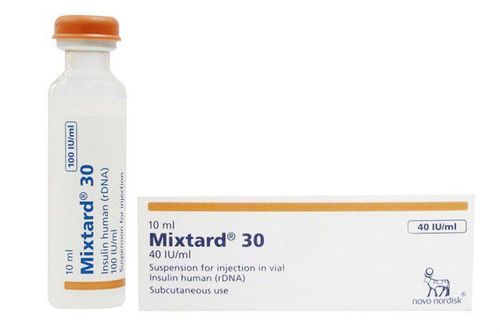
Insulatard Flexpen contains the active ingredient Human Insulin and is formulated as an injectable suspension, packaged in a box with five prefilled pens, each containing 3 mL (where 1 mL corresponds to 300 IU of Human Insulin, and each 1 IU is equivalent to 0.035 mg of anhydrous Human Insulin)
2. Effects of Insulatard Flexpen
2.1. Effects
Carbohydrate metabolism: Insulin facilitates glucose entry into cells, particularly fat, muscle, and liver cells, by enhancing glucose transporter activity at the cell membrane, thereby lowering blood glucose levels.
Lipid metabolism: Insulin inhibits fat breakdown, promotes lipid synthesis and storage in the liver, and suppresses ketone body production by inhibiting hormone-sensitive lipase activity. As a result, it reduces plasma glycerol and free fatty acid levels.
Protein metabolism: Insulin facilitates amino acid entry into cells for protein synthesis, thus promoting protein anabolism. Additionally, insulin is involved in glycoprotein formation, and its deficiency can lead to vascular structural damage.
2.2. Pharmacodynamics
When insulin binds to receptors on fat and muscle cells, it enhances glucose absorption, leading to a blood glucose-lowering effect while also inhibiting hepatic glucose production. Insulatard Flexpen is a long-acting insulin.
Insulatard Flexpen takes effect within 1.5 hours, reaches its maximum efficacy between 4 to 12 hours, and has a duration of action of approximately 24 hours.
2.3. Pharmacokinetics
In the blood, the half-life of insulin is only a few minutes, so the time-effect curve of the formulation is determined solely by its absorption characteristics. The pharmacokinetics of insulin vary significantly between patients and even within the same patient due to factors such as the injection route, dosage, injection site, type of diabetes, and the thickness of the subcutaneous fat layer.
- Absorption: Insulin cannot be administered orally as it is hydrolyzed in the digestive tract, rendering it ineffective. Intramuscular injection results in faster absorption compared to subcutaneous administration. After subcutaneous injection of Insulatard Flexpen, plasma insulin levels reach their peak within 2 to 18 hours.
- Distribution: Insulin does not strongly bind to plasma proteins, except for circulating insulin antibodies.
- Metabolism: Insulin degradation enzymes, insulin protease, or protein disulfide isomerase can cause the breakdown of human insulin.
- Elimination: The estimated half-life ranges from 5 to 10 hours, with the final half-life determined by the absorption rate from subcutaneous tissue. Insulin is excreted through the urine.
3. Indications and Contraindications of Insulatard Flexpen
3.1. Indications
Insulatard Flexpen is prescribed for the following cases:
- Treatment of patients with type 1 diabetes mellitus.
- When oral antidiabetic medications are no longer effective for treating type 2 diabetes, Insulatard Flexpen is indicated.
- Insulatard Flexpen is indicated for emergency cases in diabetic patients and is used to stabilize blood glucose levels in diabetes patients.
- Combined insulin and glucose infusion for children with poor appetite, underweight, malnutrition, metabolic disorders, or excessive vomiting.
- Inducing a severe and sudden hypoglycemic episode to trigger insulin shock therapy for psychiatric patients.
3.2. Contraindications
Insulatard Flexpen is contraindicated in patients with hypoglycemia or hypersensitivity to human insulin or any excipients in the medication.
4. How to Use and Dosage of Insulatard Flexpen
4.1. How to Use
Insulatard Flexpen is administered via subcutaneous injection and should never be injected intravenously. It is primarily injected into the thigh, but can also be injected into the buttocks, abdominal wall, or deltoid region.
Absorption is slower and more consistent when administered subcutaneously in the thigh compared to other injection sites, whereas absorption is faster when injected into the abdomen. To avoid accidental intramuscular injection, the injection should be administered into a pinched skin fold. To ensure the full insulin dose is delivered and reduce the risk of lipodystrophy, the patient should keep the needle under the skin for at least 6 seconds and rotate injection sites within the same area.
Before injection, the insulin must be mixed by moving the pen up and down at least 10 times between two positions until the suspension becomes uniformly milky white. Once mixed, the injection should be administered immediately.
4.2. Dosage
The dosage of Insulatard Flexpen varies for each individual and is determined based on the patient's needs. The dose must strictly follow the doctor's prescription.
Depending on body weight and condition, the average daily insulin dose for diabetes treatment ranges from 0.5 to 1.0 IU/kg of body weight.
Regular blood glucose monitoring helps maintain good metabolic control, slowing down the onset and progression of late complications of diabetes.
5. Side Effects of Insulatard Flexpen
Patients using Insulatard Flexpen may experience the following side effects:
- Common side effect: Hypoglycemia.
- Less common side effects: Rash, urticaria, diabetic retinopathy, edema, injection site reactions, and lipodystrophy.
Additionally, some very rare side effects include anaphylactic reactions, refractive disorders, and peripheral neuropathy.
6. Drug Interactions of Insulatard Flexpen
- Substances that reduce insulin requirements: Oral antidiabetic drugs, non-selective beta-blockers, monoamine oxidase inhibitors (MAOIs), salicylates, angiotensin-converting enzyme (ACE) inhibitors, anabolic steroids, and sulfonamides.
- Substances that increase insulin requirements: Oral contraceptives, glucocorticoids, thiazides, sympathomimetics, growth hormone, thyroid hormones, and danazol.
- Beta-blockers may delay recovery from hypoglycemia and mask hypoglycemic symptoms.
- Drugs that may either increase or decrease insulin requirements: Lanreotide/Octreotide.
During insulin therapy, alcohol consumption may either increase or decrease the hypoglycemic effect.
7. Precautions When Using Insulatard Flexpen
Precautions When Using Insulatard Flexpen:
- Insulatard Flexpen may be used in pregnant and breastfeeding women under the supervision of healthcare professionals.
- Caution is required when determining the insulin dose, as an excessive dose relative to the patient's needs may lead to hypoglycemia.
- Consistent and adequate dosing is essential, as failure to maintain proper dosage and continuity of treatment may result in hyperglycemia. If left untreated, this can progress to diabetic ketoacidosis, which may be life-threatening.
- Driving and operating machinery may be affected due to hypoglycemia. Patients should be warned and take necessary precautions to prevent hypoglycemic episodes while working.
Store Insulatard Flexpen in the refrigerator at a temperature of 2 to 8°C, do not freeze, and keep it away from the cooling element. Do not store the medication in the refrigerator when carrying it as a backup or after the first use. The shelf life is 6 weeks at a temperature below 30°C while in use.
Follow the Vinmec International Hospital website for more information on health, nutrition, and beauty to ensure the well-being of yourself and your loved ones.
To arrange an appointment, please call HOTLINE or make your reservation directly HERE. You may also download the MyVinmec app to schedule appointments faster and manage your reservations more conveniently.