1. Ovarian Cyst Surgery Options
There are two main surgical approaches for ovarian cyst removal:
- Laparoscopic Surgery: This method is typically performed for benign cysts measuring 5 to 10 cm. It offers several advantages, including less postoperative pain, shorter hospital stays, and faster wound healing with minimal scarring.
- Open Surgery: This approach is indicated for larger malignant cysts exceeding 10 cm. It allows for complete cyst removal but has drawbacks such as a longer recovery time, more noticeable scarring, and a potential reduction in fertility.
For patients who wish to preserve fertility, surgeons may perform a cystectomy, removing only the cyst while preserving the ovary. This approach helps maintain reproductive function.
However, in cases where cysts are present in both ovaries, have grown excessively large, or have caused extensive ovarian fibrosis, oophorectomy (removal of one or both ovaries) may be necessary. If both ovaries are removed, the patient will lose the ability to conceive naturally.

2. Complications of Ovarian Cyst Surgery
Potential complications during and after surgery include:
- Surgical Site Infection (SSI): Infections typically occur within the first two weeks post-surgery. The risk is lower with laparoscopic procedures compared to open surgery. Infections may arise from inadequate sterilization of surgical instruments or suboptimal operating room conditions.
- Scarring: Postoperative scars may form at the incision site, on the ovary, fallopian tubes, or within the pelvic cavity. These adhesions can reduce fertility and, in some cases, cause chronic pelvic pain. The appearance affects the patient's cosmetics.
- Delayed Conception: If significant ovarian tissue is removed due to extensive cysts, fewer functional ovarian cells remain, which may affect hormone production and ovulation, potentially delaying pregnancy.
- Cyst Recurrence: Ovarian cysts have a high recurrence rate after surgery, as their primary cause—hormonal imbalances, particularly estrogen fluctuations—persists even after cyst removal.
While surgery effectively removes existing cysts, the underlying risk factor recurrence is likely without proper hormonal management, lifestyle modifications, and regular likelihood.

In addition to the previously mentioned complications, patients may also experience:
- Intraoperative or postoperative bleeding: Excessive blood loss can be life-threatening if not promptly managed.
- Pain during and after surgery: Postoperative pain varies depending on the surgical method and the patient’s condition.
- Injury to surrounding organs: The intestines and bladder are particularly vulnerable during surgery.
Performing ovarian cyst surgery requires a high level of surgical expertise and well-equipped medical facilities to minimize complications and promote optimal recovery.
Ovarian Cysts and the Importance of Early Detection: Ovarian cysts are common among women, most benign, and carry a low risk of malignancy. However, while ovarian tumors and ovarian cancer are relatively uncommon, ovarian malignancies tend to be highly aggressive. Furthermore, ovarian cancer often remains asymptomatic in its early stages and is typically detected only through routine gynecological examinations and ultrasound imaging.
Therefore, doctors recommend that women undergo routine gynecological check-ups every 4 to 6 months to detect ovarian cysts and other reproductive health conditions at an early stage.
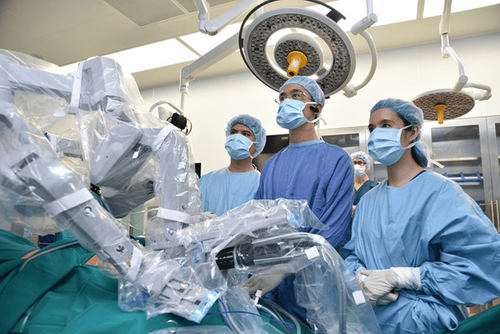
Robot-Assisted Laparoscopic Surgery for Ovarian Cyst Removal: Robot-assisted laparoscopic surgery is one of the most advanced techniques for ovarian cyst removal. This approach offers multiple advantages over traditional surgical methods, including:
- Enhanced visualization: The robotic system provides high-definition, three-dimensional imaging with greater precision than conventional surgery.

- More surgical stability: Robotic arms eliminate unnecessary hand tremors, ensuring precise movements. With four robotic arms—equivalent to two surgeons—this technology enhances surgical accuracy.
- Improved access to complex anatomical areas: The robotic system operates with six degrees of freedom, allowing it to maneuver into deep and narrow spaces that are difficult to reach using conventional techniques.
- Reduced risk of complications: Robotic-assisted surgery minimizes the likelihood of surgical complications, including infections and tissue damage.
- Less postoperative pain: Patients experience less pain than traditional surgical methods.
- Faster recovery and shorter hospital stays: The minimally invasive nature of robotic surgery results in reduced blood loss, quicker wound healing, and a shorter hospitalization period.
- Superior cosmetic outcomes: Smaller incisions lead to minimal scarring, offering better aesthetic results.
Robot-assisted ovarian cystectomy is a state-of-the-art technique currently available at Vinmec International General Hospital. Patients requiring ovarian cyst surgery can consult Vinmec’s experienced specialists to determine the most appropriate treatment plan, ensuring optimal surgical outcomes with minimal impact on reproductive health.
To arrange an appointment, please call HOTLINE or make your reservation directly HERE. You may also download the MyVinmec app to schedule appointments faster and manage your reservations more conveniently.