To achieve pregnancy, in addition to factors such as good-quality eggs and healthy embryos, the thickness of the endometrial lining is also one of the important factors that plays a key role in the successful implantation of the embryo.
1. What is the normal thickness of the endometrial lining?
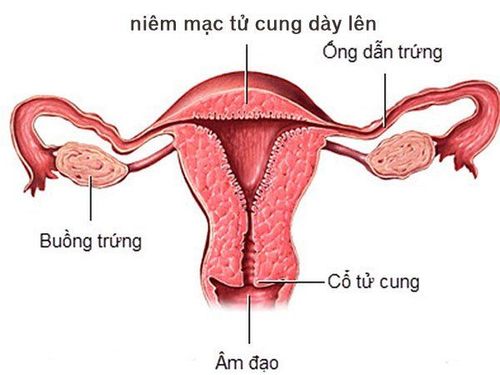
The normal thickness of the endometrial lining changes throughout a woman's life, from childhood, through the development of the reproductive organs, during pregnancy, and after menopause.
According to the Radiological Society of North America, the endometrium is at its thinnest during menstruation, typically measuring about 2 to 4 mm.
The first half of the proliferative phase begins around day 6 to day 14 of the menstrual cycle, or the period between the end of menstruation and ovulation. During this stage, the endometrial lining begins to thicken and can be measured at 5 to 7 mm.
As the cycle progresses toward ovulation, the endometrial lining continues to thicken, reaching approximately 11 mm.
Around day 14 of the menstrual cycle, a sudden increase in estrogen triggers ovulation. At this stage, the thickness of the endometrial lining is at its greatest, potentially reaching up to 16 mm.
The thickness of the endometrial lining plays a very important role in pregnancy. Reproductive specialists believe that the thickness of the endometrial lining is related to the ability to achieve a healthy pregnancy, with the lining being neither too thin nor too thick. This allows for the successful implantation of the embryo and ensures it receives all the necessary nutrients.
2. Methods for Assessing Endometrial Thickness
Measuring endometrial thickness (abbreviated as EMT) is a simple ultrasound technique that can be performed in many medical facilities. It is a reliable tool for assessing the endometrial lining, even in patients with ovarian stimulation.
3. How thick should the endometrial lining be for embryo transfer?
Most scientists agree that if EMT ≥ 8 mm, the chances of successful embryo implantation are better.
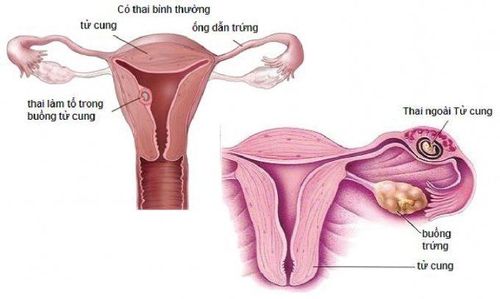
There are many causes of a thin endometrial lining, such as intrauterine adhesions. In cases of intrauterine adhesions, detection through hysterosalpingography is necessary before performing IVF. In cases without intrauterine adhesions, experts suggest that it may be due to the functional layer of the endometrium not developing properly, resulting in a thin lining.
4. How many days should the endometrium be monitored before embryo transfer?
Before embryo transfer, a woman will be prescribed certain hormonal medications, such as estrogen, starting on the first day of her menstrual cycle. The doctor will then monitor the endometrial lining until it reaches a thickness of EMT ≥ 8 mm, at which point the embryo transfer will begin.
The ideal thickness for embryo transfer is approximately 8 to 14 mm, and if it is outside this range, it may not be the most appropriate time for transfer. However, depending on specific cases, the doctor will provide guidance on the most suitable timing for embryo transfer.
To arrange an appointment, please call HOTLINE or make your reservation directly HERE. You may also download the MyVinmec app to schedule appointments faster and manage your reservations more conveniently.