This article is professionally reviewed by Dr. Tran Lam Khoa - Department of Obstetrics and Gynecology - Vinmec Central Park International Hospital
Benign lesions in the cervix are frequently observed. Although they are not cancerous, these lesions require treatment as they may impact the patient's quality of life.
1. Characteristics of the cervix
Regarding morphology, the shape of the cervix can vary depending on whether a woman has given birth. In nulliparous women, the cervix is typically round. In those who have given birth, the cervical opening may be enlarged horizontally.
Histologically, the external cervix is covered by a stratified squamous epithelium (squamous cells). The interior of the cervical canal is lined by glandular epithelium (simple columnar epithelium). The transformation zone at the external cervical os represents the boundary between the squamous and glandular epithelium. During pregnancy, the cervix partially dilates, revealing a portion of the glandular epithelium of the cervical canal. Following menopause, the epithelial layer on the outside becomes paler, and the histological boundary retreats deeper into the cervical canal.
2. Common benign lesions of the cervix
The cervix is the lower segment of the uterus, consisting of a portion located within the vagina and a portion above the vagina. The segment within the vagina is directly affected by various physiological or pathological changes, such as hormonal fluctuations, age, reproductive activity, vaginal pH, as well as infections from viruses, bacteria, and parasites, leading to a variety of benign lesions.
2.1 Non-specific lesions
Cervicitis
The causes of cervicitis are often bacterial agents found within the vagina, such as Neisseria gonorrhoeae, Treponema pallidum, bacteria causing chancroid, Herpes Simplex Virus, Human Papillomavirus (HPV), Chlamydia trachomatis, and Trichomonas vaginalis. Symptoms include a reddened cervix, cloudy, mucoid vaginal discharge often resembling yellow-green pus, and an unpleasant odor. The inflamed area may be covered by a pseudomembrane and can bleed upon contact.
Cervical ectopy
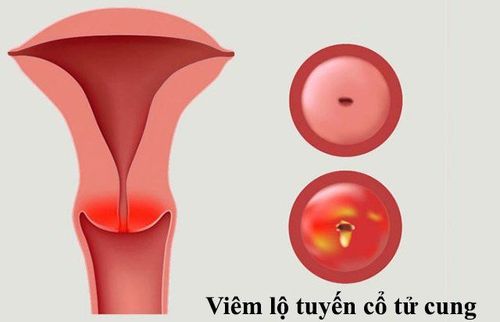
Cervical ectopy is characterized by the presence of glandular epithelium on the external cervix, primarily occurring after pregnancy and childbirth due to incomplete regression of ectopic cells during pregnancy. A small number of cervical ectopy cases may be congenital.
Upon examination, the squamous epithelium appears rough and reddened, often covered by a layer of mucous. When 3% acetic acid is applied, the mucous coagulates. Colposcopy may reveal a grape-like appearance, and Lugol’s solution does not stain (negative).
For treatment, if cervical ectopy is not associated with inflammation, it may resolve spontaneously. In cases of extensive ectopy that causes significant discharge and is associated with inflammation or recurrence, treatment with specific anti-inflammatory medication is required. Following this, methods such as thermal ablation, chemical ablation, electrosurgery, or cryotherapy may be utilized to destroy glandular epithelium, facilitating the restoration of squamous epithelium. Ectopy ablation is usually indicated 3 to 5 days post-menstruation. Ablation should not be performed in patients who are pregnant, experiencing acute vaginitis, or displaying suspicious lesions.
Benign cervical hyperplasia
• Nabothian cysts: These occur when the squamous epithelium covers the glandular epithelium without fully replacing the underlying glandular tissue, resulting in the continued secretion of mucus by the glands, which leads to cyst formation. These cysts vary in size and may appear translucent, opaque white, or pale yellow, and may contain blood vessels on the surface. Inside the cyst is mucous secreted by the glandular epithelium. When a cyst ruptures, it leaves a cystic opening.
• Endocervical polyp: A squamous epithelium of metaplastic origin encircles an opening to a gland.
• Glandular inclusion: A metaplastic squamous epithelium encircles a region of extended glandular epithelium.
These are benign transformations in the cervix, but during the process of squamous epithelial regeneration, abnormal transformations may occur; thus, careful monitoring is necessary. For benign post-inflammatory sequelae, if minimal, anti-inflammatory treatment may suffice for spontaneous recovery of the squamous epithelium. Severe cases may require ablation or aspiration of Nabothian cysts.
2.2 Specific inflammatory lesions
Cervical tuberculosis
Isolated cervical tuberculosis is rare. It generally occurs concomitantly with pelvic tuberculosis and endometrial tuberculosis. The condition manifests as ulcerative lesions, exophytic growths, and a tendency to bleed, which can be easily misdiagnosed as cervical cancer. Diagnosis through biopsy will reveal granulomas and specific inflammatory cells.
Chancre of syphilis
A chancre may occur on the cervix, presenting as a firm ulcer with well-defined borders, a propensity to bleed, and often accompanied by lymphadenopathy. Laboratory examination will reveal the presence of Treponema pallidum, the causative agent of syphilis.
2.3 Other Lesions
Cervical Polyp
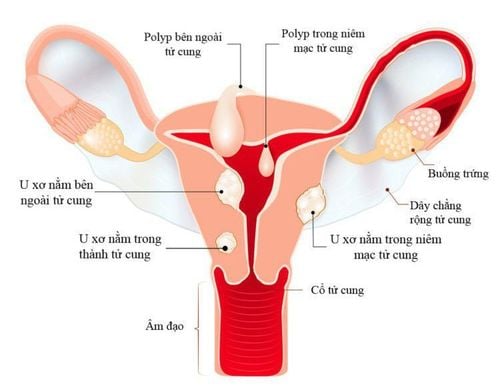
This is a benign mass that develops from the stromal tissue of the cervix, covered by columnar epithelium. Subsequently, the polyp may undergo metaplasia to become squamous epithelium, typically presenting with a small stalk, soft tissue, arising from the cervical canal, which may protrude from the body or isthmus of the cervix. The size can vary from a few millimeters to several centimeters and is commonly observed in multiparous women.
Patients with cervical polyps are often asymptomatic. Occasionally, patients may experience increased vaginal discharge, intermenstrual bleeding, or bleeding post-coitus. Smaller stalked polyps may be twisted with forceps. During treatment, it is essential to evaluate the base of the polyp; if the base arises from the uterine cavity, hysteroscopy should be performed to excise the polyp.
Cervical Endometriosis
This condition involves the ectopic presence of endometrial cells. Endometriosis in the cervix is typically evident after menstruation, manifested as small, solitary, blue-purple or dark nodules scattered around the cervix. These nodules are likely to enlarge and become more pronounced during menstruation.
The appropriate treatment method for this condition is the ablation of the endometriotic lesions.
Cervical Fibroid
Cervical fibroids usually present as protruding, firm masses that may occasionally obscure or obliterate the cervix. The suitable treatment method is the excision of the fibroid.
Cervical Condyloma
Condylomatous lesions may occur in both the vaginal wall and the cervix or solely on the surface of the cervix. During pregnancy, condylomas often proliferate rapidly and extensively. To treat this condition, physicians commonly recommend electrocautery, laser ablation, or cryotherapy.
3. Diagnosis of Benign Lesions of the Cervix
3.1 Clinical Diagnosis
The cervix can be visually inspected and palpated during examination:
• Vaginal Examination: Evaluates the size of the cervix, its density, and detects pain upon cervical manipulation;
• Speculum Examination: Allows for the observation of lesions such as inflammation, cervical polyps, and cervical canal inflammation. Furthermore, this method enables the physician to collect specimens for Gram staining, cultures, Pap smears, and thin-layer cytology for cervical cancer screening.
3.2 Paraclinical Diagnosis
• Direct Biopsy: Colposcopy assists in assessing the benign structures of the cervix’s surface, transformation zone, cervical dysplasia, polyps, or ectropion. After applying acetic acid, atypical lesions such as dysplasia, precancerous changes, and cancer may be detected, facilitating targeted biopsies;
• Cone Biopsy: This is a large biopsy technique that retrieves the ectocervix and transformation zone, capturing lesions in areas that are not visible during colposcopy.
4. Prevention of Benign Lesions of the Cervix

• Benign lesions are often related to infections and multiparity. Therefore, women should prioritize hygiene during menstruation, personal hygiene, and hygiene pre- and post-coitus;
• Annual gynecological examinations for early detection of lesions, formulation of treatment plans, and monitoring;
• Screening for HPV infection risk, along with vaginal-cervical cytological exams to detect early precursors of cervical cancer;
• Complete treatment of lesions in the cervix to prevent abnormal regeneration.
Most benign lesions of the cervix are not life-threatening; however, they can significantly impact reproductive health. Therefore, it is recommended that women undergo regular gynecological check-ups and cervical cancer screening as per guidelines.
Currently, the International Vinmec General Hospital system offers a basic gynecological examination and pathology screening package.
Read more:
To arrange an appointment, please call HOTLINE or make your reservation directly HERE. You may also download the MyVinmec app to schedule appointments faster and manage your reservations more conveniently.