The physiological curvature of the spine refers to the natural spinal curves in a normal person. In a healthy individual, when the spine is viewed from behind in an upright position, it appears as a straight line from top to bottom (from the first cervical vertebra (C1) to the tip of the sacrum). Any bending or deviation of any part of the spine to the right or left is considered abnormal and requires identifying the cause for treatment.
This article was written by an Orthopedic Trauma Surgeon - Department of General Surgery - Vinmec Central Park International General Hospital
1. Physiological curvature of the spine
In adults, the human spine consists of 7 cervical vertebrae, 12 thoracic (or dorsal) vertebrae, 5 lumbar vertebrae, and 5 sacral vertebrae fused into one bone called the sacrum. The two lateral borders of the sacrum form the sacroiliac joints, which articulate with the two hip bones. The final 3-5 vertebrae fuse naturally to form the coccyx (tailbone), which plays an important role in supporting the body in a sitting position.
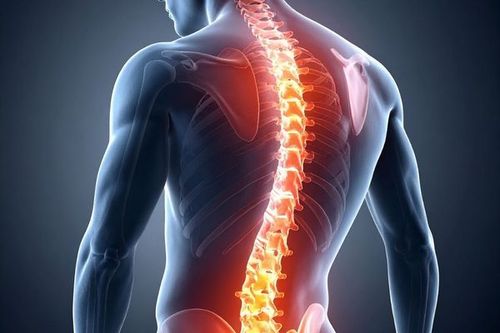
When viewed laterally, the spine forms a smooth, gentle curve from the neck through the back, lower back, and down to the sacrum and coccyx - this is the physiological spinal curvature. If the spine does not curve smoothly as shown, or curves in the opposite direction, it is considered abnormal and the cause should be identified.
- The normal physiological curvature of the spine, when viewed from the side, shows:
- The cervical spine is lordotic (curving inward), with an average angle of 20-40 degrees.
- The thoracic spine is kyphotic (curving outward), with an average angle of 20-40 degrees.
- The lumbar spine is lordotic, with an average angle of 40-60 degrees.
- The sacral vertebrae, fused into one bone, form a kyphotic curve.
The transition between these curves - from cervical lordosis to thoracic kyphosis, from thoracic kyphosis to lumbar lordosis, and from lumbar lordosis to sacral kyphosis - occurs gradually. Any sudden or abnormal change in these directions is considered pathological and should be investigated.
2. Loss of physiological spinal curvature
Abnormal spinal curvature can occur at varying degrees. Nowadays, many patients undergoing spinal imaging such as standard X-rays, CT scans, or MRI are reported by radiologists as having “loss or reduction of physiological spinal curvature.”
In reality, loss of spinal curvature refers to a subtle or mild abnormal change in the curvature of a segment of the spine.
Examples:
- The cervical spine shows reduced lordosis (<20 degrees), appears straight, or has slight kyphosis in a few vertebrae.
- The thoracic spine shows reduced kyphosis (<20 degrees) or appears straight instead of smoothly curved (20–40 degrees).
- The lumbar spine shows reduced lordosis (<40 degrees), appears straight, or has slight kyphosis in a few vertebrae.
- The sacrum does not lose curvature because it is fused into a single block from early life.
Cases with marked spinal deformity are not described as simple loss of curvature but as spinal deformity disease, commonly including scoliosis, kyphosis, or combined deformities (curving, bending, and rotation).
3. Causes of loss of physiological spinal curvature
As mentioned, loss of the spine’s physiological curvature is a mild, subtle abnormality in curvature direction.
The most common cause is poor posture habits maintained for long periods (days, months, or years), such as:
- Office workers bending the neck forward at computers for extended hours, leading to cervical kyphosis instead of lordosis.
- Laborers or cleaners bending their backs for prolonged periods, causing lumbar kyphosis instead of lordosis.
- Farmers squatting long hours when working, leading to lumbar curvature loss.
Additionally, certain diseases in surrounding organs may cause acute or chronic unilateral pain, leading to muscle spasms on one side of the spine, resulting in abnormal curvature and loss of physiological alignment.
4. What to do when imaging results show loss of spinal curvature?
Loss of physiological spinal curvature is not a disease, but an indirect sign of an underlying spinal or paraspinal condition.
The best course of action is to consult a spine specialist to determine the cause and treat it appropriately.
If the condition results from poor posture or occupational habits, self-correction is essential:
- Avoid maintaining poor posture for long periods.
- Exercise and move regularly.
- Strengthen core and back muscles.
- Change positions frequently to prevent prolonged muscle strain.
X-ray of the cervical spine:
- Left image: normal cervical curvature.
- Right image: loss of physiological cervical curvature — the spine is straightened, and from C4 to C6 there is mild, subtle kyphosis.
X-ray of the lumbar spine:
- Normal curvature: lumbar spine shows physiological lordosis.
- Reduced curvature: lumbar spine appears straight or slightly kyphotic instead of curving forward 40–60 degrees.
- Loss of curvature due to degeneration: slight kyphosis from L1 to L3 instead of forward curvature.
Abnormal spinal curvature can occur at different levels and due to many causes. Therefore, if you experience spinal problems or notice abnormal curvature, you should visit a medical facility for examination and treatment.
Vinmec International General Hospital is a multi-specialty hospital specializing in the diagnosis and treatment of musculoskeletal disorders such as arthritis, degeneration, herniation, and chronic joint pain. Vinmec applies advanced medical technologies for accurate diagnosis and effective treatment, minimizing recurrence and complications. Its success is supported by modern facilities and a team of highly qualified, experienced physicians, providing optimal treatment outcomes for patients.
To arrange an appointment, please call HOTLINE or make your reservation directly HERE. You may also download the MyVinmec app to schedule appointments faster and manage your reservations more conveniently.